

 The protagonist of this story, Ata, is the illegitimate daughter of the deceased princess of Pandi and an unknown Cinnaen. Her features reflect this, as she is quite fair-skinned and has vivid green eyes (like the northern Cinnaens), but she is a dark brunette (though her mother was stereotypically black-haired, like most Pandial). Ata is quite tall and tends toward being slim rather than muscular, despite attending regular military training sessions as is expected in Pandial society.
She has even and pleasing features, with an eye-catching kind of attractiveness. Despite being a member of the Pandial royal family, her role is more practical and utilitarian in nature and her wardrobe reflects this, with simple tunics and leggings, some leather vambraces and belts to carry her various knives, daggers, and swords, as well as her preferred weapons—her bow and arrows.
For a significant part of the book, she makes use of trees in the forest as shelters while surviving the invasion by the Gruxhoon. She is intelligent and resourceful, loyal and stubborn, and she loves those close to her fiercely (though, she takes time to let most people in). Despite her serious role in the Pandial court and somewhat sad childhood, she has a silly streak as well, and has a healthy sense of humour, laughing often when with her loved ones. She is also perceptive and sees those who are downtrodden, as well as having a very strong moral compass, despite the difficulties which her position and role as spy cause.
 Svens (Svensso) is the illegitimate son of the deceased Cinnaen king, which means that he has this in common with Ata. Although he becomes the main interest, they do not particularly like each other initially, as he is uncompromisingly loyal to his kingdom and family, and knows she is a spy. He is very tall and fair, with eyes that are pale blue. He looks “typically” Cinnaen, according to Ata’s first description of him—although she notes that he looks very similar to the Vürgøn, which makes sense considering the shared history of these two ethnic groups. Here is the description Ata catalogues in her mind when she meets him for the first time (in the book):
“Lord Svensso, general of Cinnae’s eastern armies, illegitimate son of the late King Olefso, elder half-brother to the crown prince […] He was tall, as even hunched he dwarfed his two neighbours and made the outlandishly ornate chair he sat in seem proportionate.”
As mentioned, they don’t initially like each other because he is a stickler for morality and dignity while she is an unknown variable and a potential danger to his country and family. Eventually, due to the Gruxhoon invasion and the necessity of the Cinnaen court seeking refuge with the Pandial, a marriage is arranged between their respective families to tie the royal lines together, but with members that wouldn’t necessarily influence the political alliance too much. Ata hates being forced into it, but Svens is more amenable because he prizes duty above all else (and, even though he refuses to admit it even to himself, he has a strange fascination with Ata). From then onwards, their relationship develops despite Ata’s open antagonism and Svens’s stoic responses.
The official colours of the House of Hårbørgen (the Cinnaen ruling family) are pale blue and silver, which suits the colouring of its members (all very fair and pale-skinned), and the Cinnaen kingdom has a more advanced sense of art and fashion than its southern neighbour Pandi. It is also generally colder there, it being more northern (especially Hårbørgen Palace), so Svens tends to wear velvets and furs; tunics of excellent quality, yet highly manoeuvrable when necessary (he has been in the Cinnaen military his entire life, and had been elevated to general of all their eastern armies before his father, the king’s death). His preferred weapon is a bastard sword, which is a mix between a one-handed and two-handed sword.
Towards the end of the novel, Svens becomes the envoy to the Vürgøn tribes (similar in their habits and styles to Vikings), and begins to adopt their habits of having facial hair (i.e., a full beard), and long hair (which they braid and style similarly to Vikings); his clothing also shifts to being more well-worn, as they are trapped in a continent-wide war, and his participation and practical nature do not allow him to be at court as often, and also not to prioritise the aesthetics of his clothing.
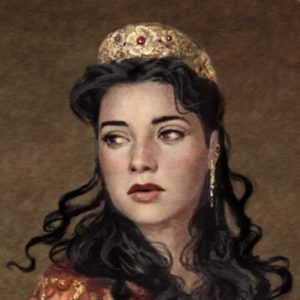 Ata’s cousin, and legitimate daughter of Kind Addai (Ata’s maternal uncle), Min (Mindaia) is the heir to the Pandial throne and is less than a year younger than Ata. She looks stereotypically Pandial, with deep black, wavy (verging on curly) hair, a tan skin, and dark eyes. Despite their difference in colouring, the two cousins resemble each other strongly in terms of build and features, though Min is a bit “softer”, physically, than Ata, due to being mostly busy with court and administrative responsibilities and only doing her mandatory military training/service a few weeks per year. Min is serious, thoughtful, and quiet, but has an inner strength and resilience (similar, yet distinct from Ata’s). She is much more self aware than Ata, and analytical about situations and people (again, similar to Ata, but without the cynical edge her illegitimate cousin has developed over the years).
Due to the fact that Min and Ata were kept largely separate (at least, as far as their public personas), she didn’t enjoy the same amount of freedom as Ata, and thus often felt left out of Ata’s and Kai’s close friendship while they were growing up (although she was often present, and they included her as much as possible). She also had a crush on Kai, a commoner, for most of her childhood, and when they were sixteen, she and he began a romantic relationship—which they’ve only been able to hide for all these years because Ata has tacitly agreed to pose as Kai’s love interest in the eyes of the court and Enddaian Keep. Min and Kai are deeply in love, though their personalities are highly disparate, but you can sense that their love won’t necessarily end well; he is a commoner, and even in their Pandial society, where military service could elevate someone’s status, a princess (and future queen), is well beyond the reach of a silversmith’s son.
Pandial fashions are more vivid in terms of colour, than Cinnaen ones, as well as making use of lighter fabrics and symmetrically patterned fabrics. Culturally and visually similar to our Mediterranean during the late medieval period, Min’s clothing is a blend of almost Byzantine-esque ostentation and early-Renaissance silhouettes, with golden headdresses and jewellery, and bold, warm colours.
 Kai (Kaimam) is a happy-go-lucky jackanapes who has worked his way up to the position of Lieutenant in the Pandial military. He and Ata have been best friends since they were seven years old because they were both shunned by their Pandial/Enddaian peers for having Cinnaen heritage, and this made them cling to each other tightly. Kai is an excellent foil to both Ata’s more repressed humour, as well as Min’s quiet restraint, however, his joviality covers a highly competent strategic mind and a sometimes-brutish physical strength. He appears not to let things get to him and lives very much in the moment, being playful (almost to the point of flirtatiousness) with others, though he is implicitly trustworthy and deeply devoted (and loyal) to Min.
Kai, like Min, is an attractive stereotype of Pandial features—black, wavy hair an tan skin—however, his eyes are a testament to his Cinnaen grandmother: they are hazel with strong green elements. He is also, like most of the rough-and-ready comrades he fights and trains with, supremely unconcerned with his appearance, and wears tunics in practical, hardy fabrics and practical colours that easily camouflage in natural environments, as well as fighting leathers rather than the metal armour favoured by the wealthier Pandial lords and most of the Cinnaen soldiers. His preferred weapons are two short swords.
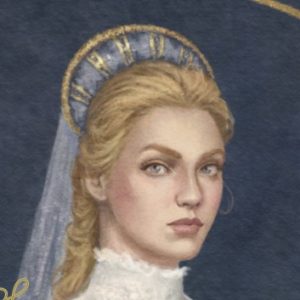 Len (Lenna) is the only Cinnaen princess, of the House of Hårbørgen, and is Svens’s younger (legitimate) sister. She and the crown prince of Cinnae, Tensso, are twins, but due to their society being strongly paternalistic, she has no claim to the throne. She has a quiet, controlled persona, but is increasingly determined to make herself matter in the greater scheme of things. Though she’s only sixteen years old, she has an intense sense of duty, she feels sympathy for those without power rather than being loyal to the idea of a kingdom or its ruling class.
Lenna feels driven to contribute to the war effort in various ways, and enjoys the increased freedom the downfall of their kingdoms has given her (having been severely repressed and controlled at the Cinnaen court by her mother, the queen’s, controlling personality and the strictures of Cinnaen society.
Lenna (like all the Hårbørgen siblings) resembles Svens strongly, though she isn’t as pale or as fair due to their mother’s more golden tones. Len has golden-blond hair and bright blue eyes, and tends to wear very effeminate laces and decorative embroidery on pale silks and satins. She covers her hair as required in Cinnaen society for women, wearing headdresses similar to French hoods (in the Tudor era) as well as gauzy veils so her intricate hairstyles and silver hair ornaments are on display. She is physically petite and always fully covered with her clothing being highly structured (e.g., corsets/boning on her torso), such as with Tudor dresses’ design and silhouettes.
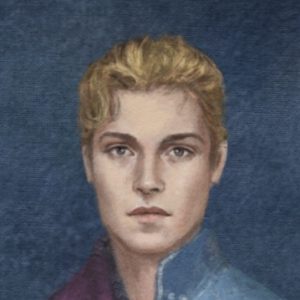 Tens (Tensso) is the heir apparent to the Cinnaen throne, and very much under the thumb of his mother and her ministers. Thus, he is eager to break free and yearns to be a part of all the military skirmishes (as Svens is) while mostly being kept at safely in the castle “for his own good”. He is a good-looking boy of sixteen, and is Lenna’s twin brother, so they share similar features and the same golden hair and bright blue eyes. Tens tends to be sullen most of the time, until he eventually gets his way and is permitted to join the fight against the Gruxhoon.
He is dressed in ostentatious velvets and furs most of the time, even when on campaign, as his persona as “future king of the Glorious House of Hårbørgen” must always be upheld (despite his often being embarrassed amongst the other fighters by his servants and their coddling). He is therefore only ever seen in the official colours of his house—pale blue and silver—as well as light armour. Though he is a competent enough fighter, he never gets the opportunity to put his skills to any use.
He has a harmless (though somewhat embarrassing) crush on Ata, which becomes even more awkward when she marries his half-brother, Svens, whom he both idolises for his military prowess and envies for his (mistaken belief) believe that Svens enjoys immense freedom to be who he wants to be. Tens also sometimes resents Svens’s advice and guidance, because he is finding his way to becoming an adult, and feels embarrassed when his shortcomings are addressed by his seemingly “perfect” half-brother. Despite these minor issues between the siblings (and the fact that the queen is a controlling and unstable influence in their lives), the Hårbørgen princes and princess are a surprisingly closeknit family.
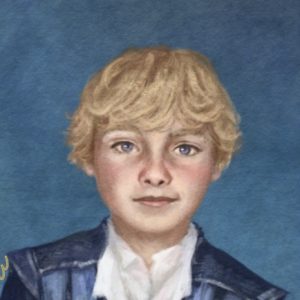 One of the two younger princes of Cinnae, Jans (Jansso) is six years old with a stubborn streak, though generally lovable and amenable towards the people he loves and trusts. As there is a bit of an age-gap between him and his older siblings (including Svens, his half-brother, who is technically old enough to be his father), he acts somewhat like an eldest sibling toward his younger brother, Elsso. Like his siblings, Jans is golden-blond (although, a darker shade than his older siblings), and serious blue eyes.
During their cross-country escape, Jans tends to question Ata’s decisions and pushes back quite often, but once he forms a bond with her, he is her staunchest ally amongst the Hårbørgen clan. His greatest ambition is to become as strong and wise as Svens, whom he idolises (although, again: his rebellious spirit, married with his excessive fondness for logic, means that he pushes back on some of Svens’s edicts regarding Ata).
As a little prince, he is always immaculately dressed in the traditional Hårbørgen colours of pale blue and silver, but he has started to exert his will in this too, and likes to insist on darker shades of blue just to be different.
 Still very young in both behaviour and age, Elsso’s character hasn’t fully asserted itself yet. He is the youngest of the Cinnaen royals, and at the age of three, is his older brother, Jans’s, little shadow. He mimics his older sibling faithfully, but has a gentle soul and follows the instructions given him by those that care for him. He is a bit spoilt, both in terms of affection from his siblings, and in terms of having his way with their nurses and carers (although, his mother, the queen, only interacts with her children when the situation demands it).
Els is a chubby, lovable figure, with cherubic features and pale (almost white) hair (similar to Svens’s, when he was a child), and darker blue eyes than all of his siblings. He is often dressed in frilly, ornate clothing that might seem effeminate to his (eventual) older self, but as Jans begins to combat the styles forced on them by their nannies, Els follows suit and begins to rebel against the baby-ish tunics and bibs.
 King Addai is in his early fifties, and the ruler of the Kingdom of Pandi (as well as being Min’s father and Ata’s uncle). He is a highly competent and intelligent character—sometimes harsh and brutal in his dealings with others, due to duty demanding it—but he has an ebullient kind of humour, under the correct set of circumstances. He knows his kingdom well, having travelled extensively throughout his youth in preparation for his role as king (and upon the express orders of his father, who was strict to the point of being tyrannical, but upheld a set of beliefs without exceptions for his own children). King Addai looks typically Pandial, with black, wavy hair (now going iron-grey at the temples), as well as sporting a beard (also greying). He has very dark brown eyes, and a serious mien most of the time, due to the cares of running a kingdom under siege.
He wears opulent fabrics in the fashion of late medieval kings, in rich mustards, golds, and reds, but in essence he is a practical man, so there is very little ornamentation besides his crown (on occasion), and his Enstroi chain (which, in his case, looks almost exactly like a Tudor livery collar, and which he wears openly in the same manner as a sign of his office as ruler and servant of his people). He also leads his armies into battle, when the occasion calls for it, so he is a man of action and always armed with a sword and dagger.
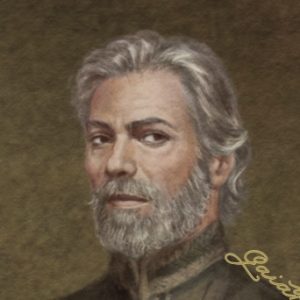 Lord Danai is the Pandial spymaster (though, not openly acknowledged as such—merely as an adviser to the Pandial king, although Ata also suspects him of dabbling in assassinations, on occasion, on behalf of the crown) as well as Ata’s mentor since childhood. He is around sixty years old and has the dark features and eyes of a typical Pandial, including wild, iron-grey hair and a full beard. His manner is blunt and he has a very dry wit, as well as being almost clinical in his interactions with everyone. Thus, his stare isn’t warm or inviting, but direct and incisive. To most, he would come across as a coldly calculating man, as well as being quite mysterious.
He wears dark, sombre colours in nondescript styles to avoid drawing the eye, and has a foreboding air about him. Ata has never seen his Enstroi chain.
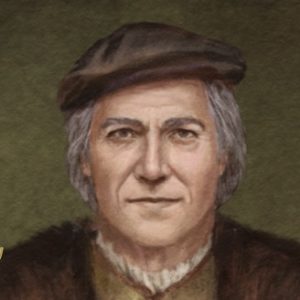 Lord Iansso is Lord Danai’s equivalent at the Cinnaen court—spymaster and “other” (“other” being nefarious things required by the crown). However, his entire approach and demeanour differ completely from his taciturn Pandial counterpart’s. He is warmly inviting and charming in his interactions with all, a twinkle always to be found in his bright blue eyes. He is witty and kind to those beneath him in status, while being playfully deferential to those above him in status. Beneath the surface of his jocularity, though, lies a myriad of secrets and knowledge, as well as skills best left unknown by the squeamish. He is dangerous, not despite his charming “harmlessness”, but because of it. Luckily, he appears to take an immediate liking to Ata, despite her being exposed as a foreign spy at his court, and despite the fact that he is Svens’s mentor (and Svens initially takes a strong dislike to Ata).
Ians has stick-straight, monochromatic silver hair that is cut into a bowl (longer than the Normans during the invasion of Britain in 1066, but the shape quite similar), and wears various colours (though usually dark, rich shades like plums and maroons) in warm fabrics like wools and velvets. He also tends to wear shapeless hats (reminiscent of those worn by thinkers during the Renaissance and Tudor periods).